










News
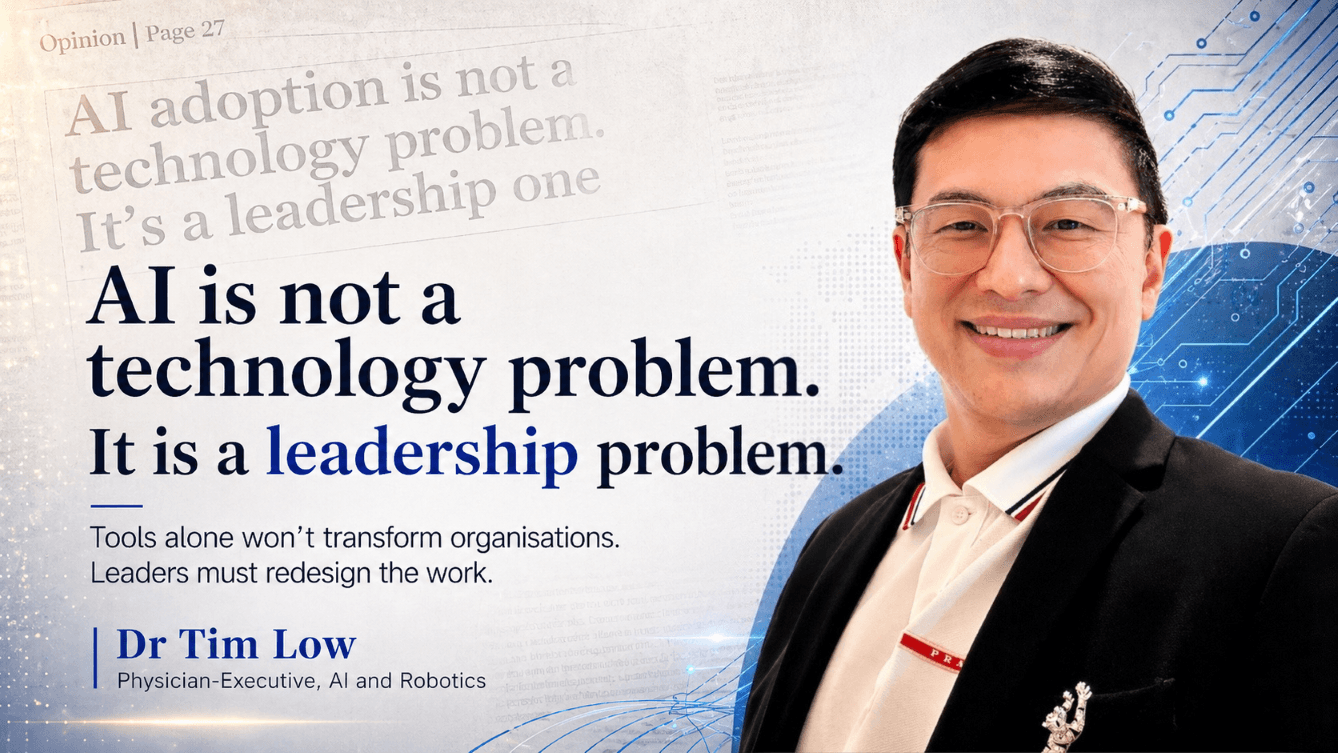
AI adoption is not a technology problem. It is a leadership courage problem.

Author: Dr Timothy Low
The recent Straits Times opinion piece by Amit Joshi made a point that many boardrooms need to hear:

Companies are spending heavily on AI.
Tools are everywhere.
Pilots are multiplying.
Dashboards are glowing.
Yet productivity gains remain uneven.
Why?
Because many organisations are using AI to make old work faster, instead of redesigning work itself.
That is the uncomfortable truth.
AI does not transform broken workflows.
It exposes them.
As a former hospital CEO, board member, healthcare investor, and now working at the intersection of healthcare, robotics, and autonomous logistics, I have seen this pattern repeatedly.
Healthcare loves innovation in theory.
But in practice, we are often too cautious, too committee-driven, and too slow to redesign the operating model.
We will adopt AI for documentation.
AI for triage.
AI for imaging support.
AI for chatbots.
Useful? Absolutely.
But if the patient journey remains fragmented, clinicians remain overloaded, departments remain siloed, and logistics remain manual, then AI becomes another shiny digital layer sitting on top of an old analogue system.
A digital plaster on an operational wound.
The same applies to hospital logistics.
Medicines still move manually.
Specimens still depend on porters.
Nurses still spend time walking instead of caring.
Supplies still get delayed between pharmacy, wards, labs, theatres, and departments.
In many healthcare organisations, the last mile is still the weakest mile.
And yet, this is exactly where robotics, Agentic AI, and autonomous last-mile delivery can unlock real productivity.
Not by replacing people blindly.
But by removing repetitive, low-value movement from already stretched clinical teams.
This is where the future of healthcare operations is heading:
🔹 Robots that move hospital goods autonomously.
🔹 Agentic AI that understands tasks, priorities, and exceptions.
🔹 Smart infrastructure that allows robots to interact safely with lifts, doors, corridors, and buildings.
🔹 Logistics systems that are governed, auditable, and scalable.
🔹 Healthcare teams freed to focus on patients, not parcel movement.
But technology alone is not enough.
Hospitals do not need more isolated pilots.
They need leadership conviction.
They need to ask harder questions:
📍What work should humans no longer be doing?
📍Which workflows are relics of a pre-AI world?
📍Where are we confusing busyness with productivity?
📍Are we measuring real outcomes, or just faster activity?
📍Are we protecting old processes because they are safe, or because change is uncomfortable?
The irony is this.
Healthcare is one of the sectors that stands to gain the most from AI and robotics, yet it is often one of the slowest to adopt them at scale.
We speak about patient-centred care, but still tolerate operational designs that pull clinicians away from patients.
We speak about workforce burnout, but still allow nurses and support staff to perform tasks that intelligent automation can increasingly handle.
We speak about digital transformation, but still think in departmental silos rather than end-to-end systems.
AI will not save healthcare by simply being added to the existing structure.
It will save time, reduce friction, and improve outcomes only when leaders are willing to redesign the structure around it.
The winners will not be the organisations with the most AI tools.
They will be the ones with the courage to rethink work itself.
Because the future of healthcare will not be built by leaders who merely adopt AI.
It will be built by leaders who understand how AI, robotics, and autonomous logistics can restore the most precious resource in healthcare.
Human time.
And in healthcare, human time is not just productivity.
It is care.
💡 AI will not fix broken systems. It will simply make broken systems fail faster, with better dashboards and more expensive subscriptions.