A Younger Face Is Not Proof of Younger Biology
Why longevity aesthetics needs a higher standard
By Dr Timothy Low
Physician, healthcare leader and longevity and regenerative wellness advocate
Aesthetic medicine has become remarkably good at changing how ageing looks. The harder question is whether we are improving how skin ages.
A smoother forehead is a visible result. It is not, by itself, evidence of healthier tissue, cellular rejuvenation or longer life.
Confusing these outcomes is where marketing overtakes medicine.
My perspective, shaped by medicine, healthcare leadership and my focus on longevity and regenerative wellness, is that aesthetics must look beyond the photograph.
We should consider skin function, tissue quality, durability and the person’s overall health.
I describe this as SkinSpan: preserving how well our skin functions throughout life, alongside how it looks.
From visible correction to measurable benefit
Skin is a living organ. Ageing can make it thinner, drier and more fragile, while accumulated ultraviolet exposure contributes further damage. An attractive appearance does not tell us everything about its condition.
Longevity aesthetics therefore demands better questions:
Are we improving hydration or barrier function?
Are results sustained?
What are the risks?
Does the intervention address this person’s needs?
The next frontier should be better clinical judgment, not simply a longer treatment menu.
“Regenerative” is a claim to substantiate
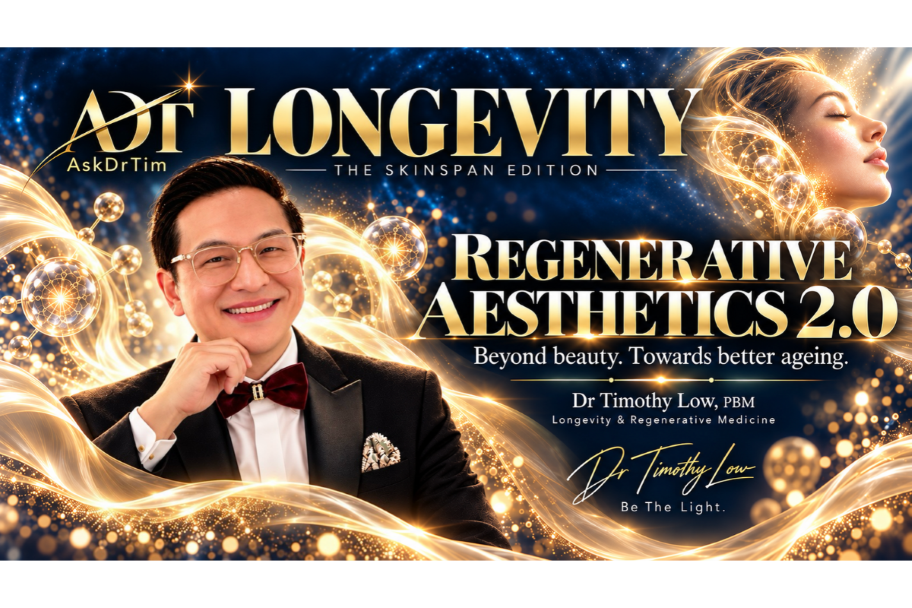
What I call Regenerative Aesthetics 2.0 is a higher standard:
Clearly characterised products, reproducible protocols, meaningful outcomes and adequate follow-up.
Emerging approaches deserve scientific curiosity. They also deserve scrutiny.
Exosomes illustrate the distinction: Commercial enthusiasm must not be mistaken for established clinical benefit. The US FDA states that there are currently no FDA-approved exosome products.
Evidence must relate to the actual product, route of administration and intended use.
A compelling mechanism cannot substitute for demonstrated benefit in people.
If a clinic cannot explain what is being administered, why it should work and how success will be measured, the consultation is incomplete.
An agenda for Asia
As this conversation develops across Asia, I believe clinicians have an opportunity to set the standard.
We should ask whether evidence applies to the patient’s skin type and clinical context, and verify local regulatory requirements.
My practical framework is straightforward:
- Protect first. Establish appropriate skin care and sun protection.
- Define the goal. Distinguish appearance, skin function and biological ageing.
- Demand relevant evidence. Assess the specific intervention.
- Measure and review. Track benefit, durability and complications.
Daily care still matters. Broad-spectrum SPF 30 or higher and appropriate moisturisation remain foundations, however sophisticated the treatment plan.
Your skin does not award bonus points for an expensive receipt.
My position is clear:
Longevity aesthetics should unite visible results with responsible medicine.
Our credibility will depend on explaining both what an intervention can achieve and what remains unproven.
The future of aesthetics will be defined by how convincingly we demonstrate benefit, not how confidently we promise youth.